BYO AI Is Not What’s Next in Digital Banking
BYO AI isn’t my term. It’s becoming the shorthand for a specific idea: your account-holders bring their own LLM — Claude, ChatGPT, Grok, whichever they’ve settled on — and use it as the front door to their bank.
Two versions are circulating.
The first puts a MCP server in front of an existing digital banking platform and goes headless, a la Salesforce. The second skips the digital layer entirely — a secure gateway straight through to the core.
The argument attached to the second version: if the interface is now somebody else’s LLM, the digital banking platform that sat between the core and the account-holder for thirty-odd years disappears. The core reclaims its position as the heavy in the tech stack. Two things can be true at once. That argument is coherent on its own terms, but it assumes a lot, and a range of objections still apply.
Both versions ignore a conditioning problem.
I’m an all-of-the-above technologist as much as I’m a skeptic, and this is interesting work. Will BYO AI happen? Yes. Should you prepare for it (or partner with a provider who can)? Yes. Large banks will enable it for AI-natives and a growing group of “AI-confidents.” There will be early adopters.
Should it be the next major financial technology investment you fund? No. And the reason has very little to do with the technology.
Assumptions…well, you know.
Every version of the BYO AI pitch assumes an account-holder who already lives in an LLM, prompts well, and trusts that tool with their money. Adoption of these tools is climbing fast. Pew now puts ChatGPT use among U.S. adults at 44%, up from 18% in 2023. Adoption of banking through them is a separate curve. Nobody has shown me the data on the second one. PNC’s card data puts paid generative-AI subscriptions at about 2% of U.S. households.
We still have people writing checks in the grocery store checkout lane. The Fed counted 9.2 billion check payments in 2024 — most of that isn’t the checkout lane, but the habit hasn’t left the building. We spent the better part of a decade getting Apple Pay to meaningful adoption at the point of sale, and it was demonstrably more secure the entire time. It launched in 2014. Merchant acceptance is now roughly 85–90%. Eleven years in, PYMNTS found it used for about 10% of eligible in-store purchases. I had to push my own tech-savvy kids to put a card in a mobile wallet. Side note: They get it now.
That is the behavior any BYO AI thesis has to overcome. The hard part is conditioning, not architecture. The industry has never solved that sort of problem quickly.
Which brings me to the questions I’d want answered before I signed the check.
1. If the front end is an LLM, what about the experience is distinctly yours?
You have spent years and real money on a curated, branded experience — the layout, the offers, the way a rate or a pre-approval gets surfaced at the right moment. Asking Grok to move $30 gets an interaction any institution on earth could have produced. The brand equity you built doesn’t transfer to a text chat. It disappears behind someone else’s interface.
2. How does BYO AI address a competence gap?
Single-intent commands work fine. “Send $100 to Sarah” is a solved problem. The valuable ask — “help me understand where my spending drifted last month and what I should do about it” — is the one almost nobody thinks to make on their own. If your account-holders have to become competent prompt engineers to get value from their banking experience, you’ve raised the cost of the relationship. Asking the average user to do homework gets you abysmal adoption rates. Same question for the third-party systems sitting behind your digital channel: who sets the default context for what gets surfaced, when, and how — your digital platform, your core, or the user guessing at prompts?
3. How does BYO AI address cognitive load without a canvas?
Decades of UX conditioning have trained people to expect information visually, at low cognitive load, already assembled. Generative AI can build a chart. It builds it after they ask, while they wait. A well-designed dashboard had it ready before they logged in. Every offer, every cross-sell, every nudge that currently earns its keep in your app has to survive translation into a conversation with an agent you don’t control.
4. How do you (re) establish trust?
People still hesitate to put a card into a mobile wallet after you’ve walked them through Face ID and the entire security model. Someone will still ask, “What if someone steals my phone?” Now ask that same person to authorize a third-party AI assistant to reach into their deposit or operating accounts. Somebody has to build the experiential waypoints that close it. I haven’t seen anyone pitching BYO AI as ‘what’s next’ building them.
5. What, exactly, do you buy with this approach?
Every platform provider with the resources to build this will build it. Whatever differentiation exists lives in implementation detail — a thin edge to compete on and a thinner one to defend.
6. Who pays for the tokens?
When consumers or business owners want to access their accounts, move money, or simply ask for insights that will help them improve their financial lives, doing so in your app creates no additional cost for them. But if they’re accessing through their LLM of choice, or through a third-party model that comes with token costs, who’s paying for that? Who at the Bank wants to explain to them that, to get the most out of the experience, they’re going to need to pony up that $20/mo for a Pro plan? If I had to choose between Netflix and my AI tool subscription, I’d be fine dropping Netflix, but I’m an early adopter. What percentage of your digital banking users do you suppose will be willing to do that?
Allow me to suggest a more urgent investment.
Think of it as X + Y = Z. Z is what your board actually wants — stable deposits, performing loans, growth in relationships. And all the key metrics you know that drive bonuses. Y is the BYO AI investment. Invest in Y alone and you’ve opened a channel to the narrow slice of the market already using agentic tools seriously. Some of them will love it. A few might move money. That can be a useful feature. It will not produce the growth your board expects.
X is intelligent visibility. Most institutions still treat the website as an SEO problem — a game built for Google rankings and a human click. Google Zero is the opposite case. If someone is even still asking Google, the answer is assembled above the results. If they’re asking an LLM, the response lives inside Claude, ChatGPT, Gemini, Perplexity, or Grok. A lot of those people never hit your site.
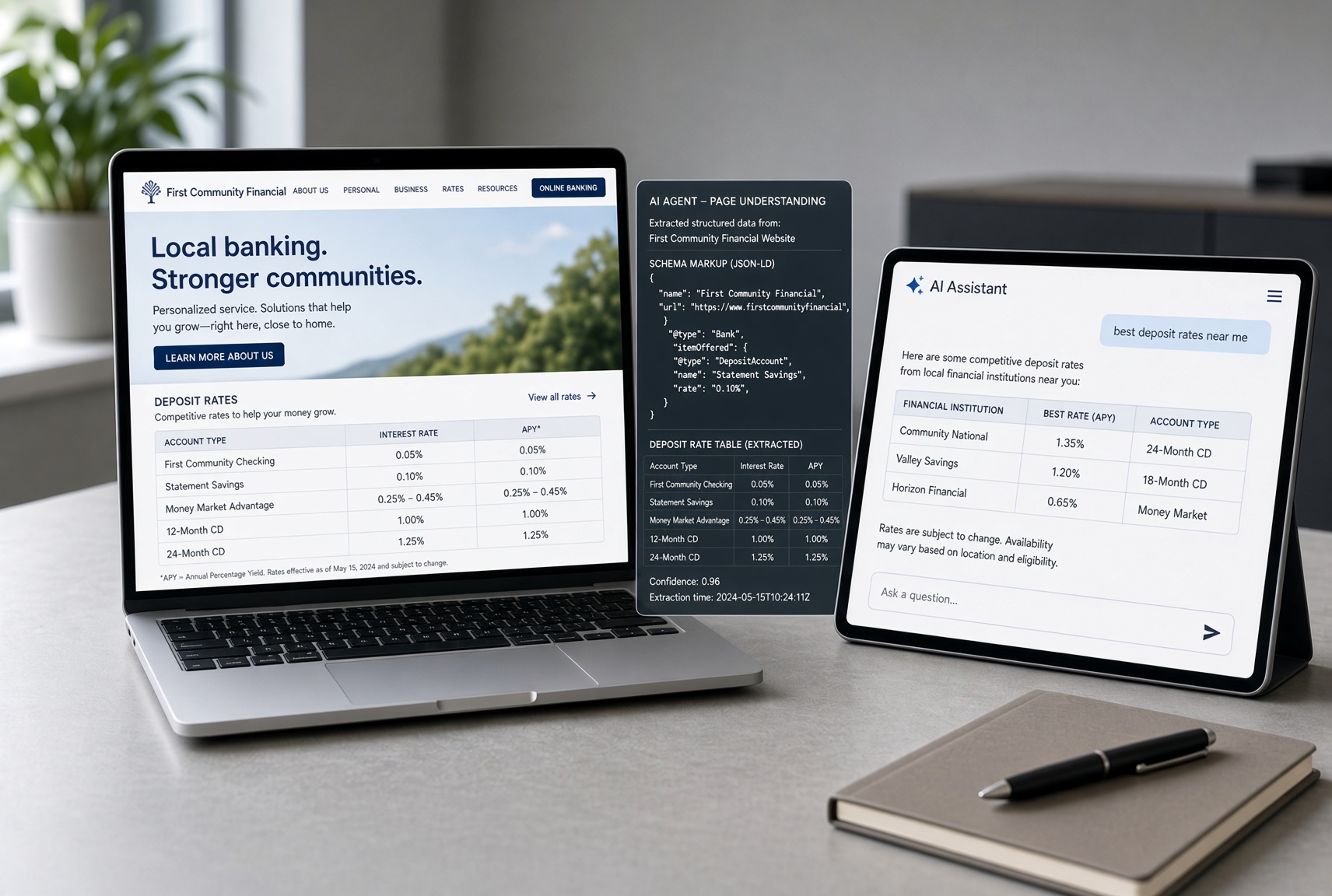
AEO (Answer Engine Optimization) and GEO (Generative Engine Optimization) are just names for making sure those engines can find you, trust what they find, and cite you when someone asks a money question without naming your institution. Intelligent visibility is that outcome: an agent discovers you unprompted in your market, describes the product accurately, compares you to alternatives, and hands the user a next step you control.
If the model never sees a current rate, a real footprint, or structured product detail, you do not exist in that conversation. You can have a beautiful website and still be absent from the interface a growing share of shoppers will use.
Everyone who was going to become a digital-first banking user already is. Growth isn’t about converting more people to digital. It’s about being the institution that gets found when someone goes looking — “best deposit rates for a $40,000 balance,” “I need a car loan — where should I go?” — and being the one they stay with once they do.
The 2026 5W Banking AI Visibility Index ran 31,500 prompts across the major engines. Bank-owned sites accounted for 6.8% of banking citations. Wikipedia, Bankrate, and Investopedia supplied 68%. Twenty-two of the top 75 U.S. banks were effectively invisible.
PRO-TIP: Before your next digital roadmap meeting, open Claude, ChatGPT, Gemini, Perplexity, and Grok. Same prompts in each. Don’t name your institution.
- “Best deposit rates for a $40,000 balance in [your primary market].”
- “Best auto loan rates in [your primary market] for a 750 credit score.”
- “Which bank or credit union should I use in [your primary market]?”
Give it five minutes. Score each answer: named, not named, or named with the wrong facts. See whether you come back at all, and what it says about you when you do. That exercise will tell you more about your 2027 growth risk than any vendor deck.
What “next” actually looks like
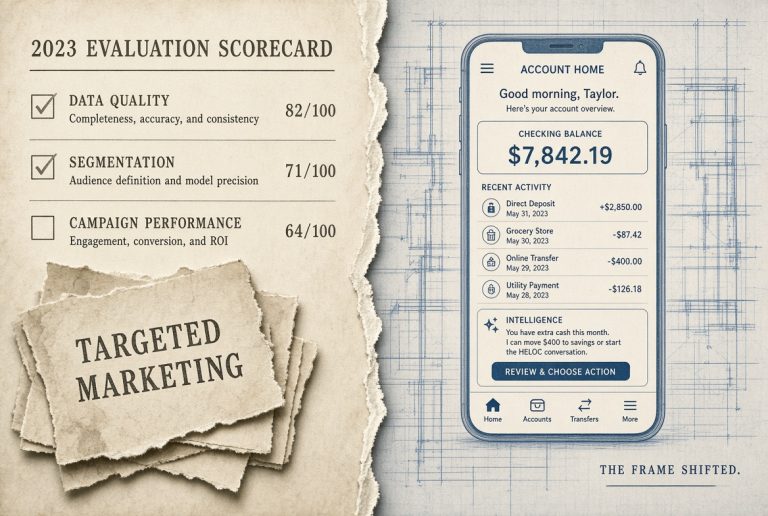
The real next step isn’t a dumb legacy system with an LLM tacked on front. It’s a digital banking platform with intelligence embedded natively in the experience — not third-party tooling bolted on around the margins.
I don’t mean “dumb system” as an insult. I mean a platform that has no intelligence of its own. Fraud detection, transaction categorization, a chatbot — those are capable tools, and they’re machine learning at the edges. A fancy chatbot can be generative-AI capable, but that’s 101-level experience. Deploying an MCP server in front of that setup doesn’t create the sort of experience you get with a legit AI-native platform.
What’s going to hold up over the next decade is a system that knows the user, adapts to them, and surfaces the insight before they ask — inside an experience you control. That’s also the most credible path to BYO AI. People who have learned what good financial intelligence feels like inside your app are the ones most likely to know what to prompt for outside of it later.
Put BYO AI on the vision board. Keep an eye on it. Don’t fund it ahead of the two things that determine whether people can find you, and whether they’ll stay once they do. If you don’t come back in that five-minute search, BYO AI is the least of your concerns.
Sources
Pew Research Center, Americans and AI 2026 https://www.pewresearch.org/chart/chatgpt-tops-the-list-of-chatbots-americans-use-across-age-groups/
PNC / CBS News reporting on paid generative-AI subscriptions https://www.cbsnews.com/news/generative-ai-subscriptions-consumer-spending/
Federal Reserve Payments Study (2024 check volume) https://www.federalreserve.gov/newsevents/pressreleases/other20260701a.htm
PYMNTS Intelligence, Apple Pay @11 (October 2025) https://www.pymnts.com/study/apple-pay-11-usage-is-up-competitors-gain-ground/
5W AI Communications, Banking AI Visibility Index 2026 https://www.5wpr.com/ai-visibility-index/banking-ai-visibility-index-2026/