
Make the Right Call.
Six critical criteria for executives evaluating digital banking in the era of intelligence
No technology decision you make will have a greater impact on the long-term relevance and competitive posture of your institution than the digital banking system you select next. Your team will still dig into features, functionality, and process. That’s their focus. Yours is to keep the evaluation pointed at the factors that actually decide whether you can accumulate stable deposits, originate more loans, and solidify relationships over the life of a 5-to-10-year technology investment.
Traditional digital banking isn’t going to cut it. Don’t settle for meeting the market where it was in 2023. Legacy thinking and generic experiences will not win and keep a household — or a new business relationship — in a crowded market for financial experiences.
Your competitive set is ruthless. And winning on relevance.
Your most serious competitor is not the institution down the street. It isn’t even the regional in the next MSA.
Cornerstone Advisors estimates that $3 trillion has moved out of traditional institutions since 2020 into fintech-led investment and savings platforms. In 2024, community banks and credit unions combined captured only 9% of new checking accounts opened. Nine percent. The other 91% went somewhere.
That 91% went to big banks, Chime, Cash App, Robinhood, Coinbase, and SoFi. Klarna and Revolut are next. Current and Varo are in the same fight for the new checking relationship. If you serve business owners, Ramp, Intuit, Mercury, Relay, Bluevine, and Block are already creating the relevance you used to take for granted.
That change in the field should change how you run the evaluation. A few mindset shifts, then the six criteria.
Embrace change.
You will spend ample time on features. Fine. Remember that whichever system you select, your staff and your active users will experience some change. I get it. Some people don’t like change. Get your selection team clear on why you’re doing this and what the net positive is — or their scorecard becomes a veto machine in favor of the status quo. Don’t forget why you started.
A modern look and feel will not differentiate you.
In 2023, how the app looked and felt was still a live fight. It isn’t anymore. Open the App Store and tap through digital banking apps at random, including ones you don’t use. I challenge you to find the one that stands out as substantially different or better. The products are strikingly similar. Every serious platform has caught up. What you face now is a sea of sameness. The margin of differentiation between traditional digital banking systems UI is razor thin. You can no longer lean on that to make a statement in your market.
“Personal” is not a marketing campaign.
Increasingly, people want and expect help managing their financial life. If you treat digital banking as a generic self-service or cross-sell channel, you’ll lose relationships to competitors focused on personal experiences in moments that matter.
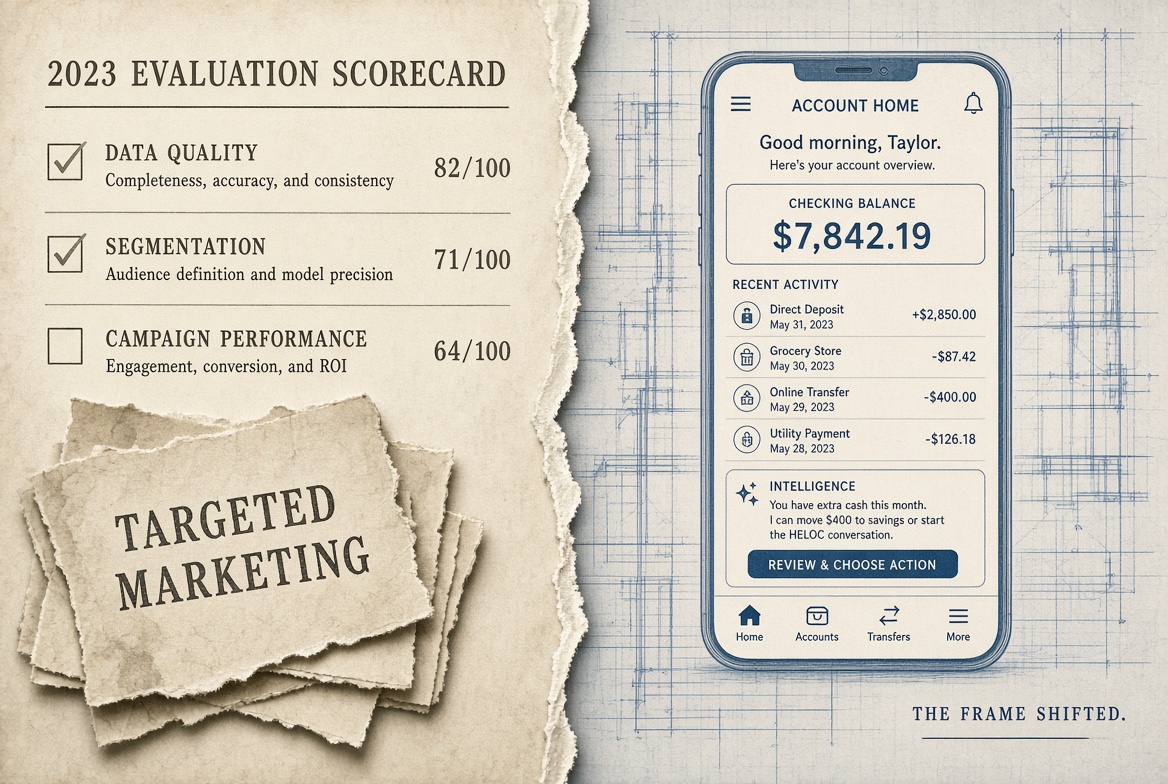
Relevance is where you’re losing today. That’s the thing you need to earn back. A prettier transaction terminal, static decision tree, or sophisticated targeted marketing engine won’t create that for you.
You earn it when the system behaves like a personal banker who understands the user’s context, guides them to what they should do next, and can actually help them do it. That’s criterion six.
1. Culture
Culture defines the long-term experience you’ll have with a partner. Most of the reasons institutions go looking for a new digital provider trace back to a vendor that was not candid, not responsive, or simply hasn’t kept its promises.
A partner worth a decade or longer seeks first to understand how you define success. That takes more time up front, and more engagement from your executive team. Skip it and you will be shopping again. I’ve watched that movie more than once over the past two decades.
You can’t properly get a sense of this unless you make sure key executives are in the room. You trust your team, and it’s tempting to let them do all the legwork. But your perspective as the executive who approves the contract must be a part of the conversation early and often. You and the rest of your executive stakeholder team should take the chance to ask the questions the project team may not be comfortable asking. And you need to be in front of that before the scorecards and the recommendation bubble up.
You want a client community that invites concrete feedback to product leadership. You want real executive sponsorship. You’re not buying a platform. You’re choosing a critical business partner. Understand how they formed their point of view, what they believe, and whether they live it.
One addition since 2023: watch talent flows, not just references. Ask whether the bench is growing or shrinking, where new people come from, and where departing people go. Don’t just accept massaged market momentum data as a proof point. A snapshot of what was tells you nothing about what’s coming.
Follow and connect with sales, relationship management, and product teams on LinkedIn and X. You may be hesitant to do that because you don’t spend much time on either platform, or because you expect a deluge of sales pitches. That’ll happen anyway. But you will find no better indicator of who’s going where and why. If you have a partner you’ve been working with and you see a ton of ‘I am genuinely grateful for my time at…’ posts, maybe it’s time to consider how that will impact your experience with them.
And ask how they measure whether they do what they said they would do. This industry has trained buyers to treat “it’s on the roadmap” as a warning label. A multi-year decision deserves a partner that can show what it promised actually shipped — and worked.
2. UX
Legacy digital systems were built to check feature boxes. How it looked came later, usually as a paint job. In 2023 I told you a prettier app was not the same thing as a better experience, and I told you to weight experience heavily. Pure-play digital banking players largely closed that gap. Unless you’re comparing to a legacy system that’s nearing end-of-life, you won’t see meaningful differentiation there.
Look and feel is the paint. UX is whether the thing works the way a person actually thinks. Design is the discipline underneath both: what shows up first, what stays out of the way, how many taps to do the job they opened the app to do. Structure, and how designers approach it, is what differentiates you here.
A lot of providers stopped at pretty. A technology player with its priorities straight staffs this like it matters, and the scale of that investment will be apparent in the experience.
Get the team aligned on the difference between how it looks and how it works, and put the real evaluation energy on criterion six. That’s where you’ll have a shot at relevance.
3. Open for business
Digital should make it easier to connect the rest of your stack and add new capabilities as the market moves. The ability to connect systems used to separate vendors. It’s the entry fee now. If a provider can’t do that at scale, you need to be thinking about the optionality you’ll have later. Building out an ecosystem is not a minor thing. And a list of a thousand single sign-ons isn’t an ecosystem.
What you should expect from any modern system is control without a construction project. Turn it on. Change navigation, colors, and logos without a ticket, a statement of work, or a six week wait. Choosing squares or ‘squircles’ shouldn’t require a project manager. That will not be why you pick a partner for a decade. It is something every finalist should be able to show.
4. Deployment strategy and tech stack
The industry used to deploy every client on its own instance of the software. That made updates slow and expensive. For most institutions without meaningful development shops, the better model is one unified platform, updated the way Apple updates the iPhone: everyone gets access to the same release and new capabilities at the same time. No waiting in line.
That argument hasn’t changed. What has changed is how much time you should spend on it. Almost every name you’ll shortlist has already made that move, or started there. The old fight over data center versus cloud deployment is largely over.
There are platforms built so they can iterate quickly and with quality. There are also platforms still scaling with duct tape and cans of Flex Seal. Validate that a provider has invested in the technology, the intellectual horsepower, and the human capital to keep its promises and deliver on its vision. Don’t waste demo weeks proving flavors of cloud or getting caught up in debates over ancillary components. You can’t afford that.
Ask what they’re doing with the technology. Understand how they’re executing with it. Ask those questions.
5. Corporate and financial stability
Ownership structure cuts both ways. Public companies give you earnings calls and a way to test whether the conversation in your boardroom matches the investor letter. They also live with the whims of institutional and retail investors, including activist pressure that can stall the investment that would have hit this quarter’s number.
A partner worth the commitment can fund the work from the business. Profitability is not a morality play. It’s whether the people who have to ship for you are paying bills without depending on the next raise, the next revolver, or another round of dilution.
Private and PE-backed look like a black box from the outside. A partner worth the commitment still runs the numbers with discipline and will show you enough to prove capacity. Public-facing opacity is not the same thing as instability. You can get the clarity you need. You can talk to the CFO. Just ask.
PE is not one story. Some firms buy a cash-cow platform, cut cost, extract cash, and sell the multiple. You inherit the husk. I have lived that, not just read about it. Others hold longer and put real capital behind a world-class team and product that can redefine a category. Same label. Very different outcome for you.
6. Real intelligence, not real-time marketing
A few years ago I’d argue the digital channel should pay for itself through data insights and marketing automation: segments, offers, and campaigns off the transaction stream. That still works. Today. The window is closing on that as the strategy. The era of intelligence is already changing how consumers and business owners discover solutions to financial needs.
Targeted marketing is entirely offer-dependent. Ask how many of your account-holders’ most important products actually sit at the institution that gets their direct deposit. A well-timed ad — in an era when anyone can instantly validate a competitive offer from the always-on, internet-connected supercomputer in their pocket — is not winning the household. The numbers I shared earlier demonstrate this.
People are more attuned to the tracking and targeting than ever before, and they don’t see it as ‘Wow, my bank really knows me.’ Anyone with an Instagram account has felt this. They know what it actually is. They don’t experience a targeted HELOC offer as care. They experience it as tracking.
‘Personalization’ is overused, and I disagree with the way many define it. Relevance is the currency — as it was when I argued the point more than a decade ago, and many times since. You won’t earn it with targeted marketing. You won’t earn it by “modernizing” digital with one of many systems that all offer the same experience your account-holders already get elsewhere.
You’ll earn it when you give them an intelligent financial operating system that knows them, guides them, and can act for them.
That is the contrast. Plenty of platforms are bolting on machine-learning based marketing tools, a chatbot, a search bar, a handful of component services — and calling that AI. Some, more boldly, are using the term ‘AI-native.’
Definitions here will matter as you think about your next steps.
AI-native software is built with AI as core to the architecture—not bolted on. AI drives the data model, workflows, UX, and continuous learning. Agents perform work inside the system, not just assist around it. There’s a chasm between ‘AI-native’ and ‘AI-powered.’
AI-native, in real terms, exists on a spectrum of ambition. At its most basic, you get a generative chatbot that draws charts and calls them insights. Context-aware, technically, and still a conversation about the relationship rather than work in the relationship. Further along the spectrum, intelligence is embedded in the experience and pointed at the thing the user needs to accomplish — accompanied by offered action, not just a dashboard snippet.
As you evaluate your next commitments, you will have to understand the scope of the ambition, then dig into whether a provider can deliver it at scale. That’s where that say-do ratio I mentioned comes in.
As a practical guide: If it cannot act inside the books, you bought a fancier chatbot. If it cannot deliver context-aware guidance for a specific person with a recommended action they can execute, you bought a search bar.
Full autonomy — people directing large parts of their financial life through agents, under controls that make that safe — is still years out. Not because the models can’t do impressive work today. But because people still treat a roundabout like a four-way stop. Despite clear convenience and security benefits, a lot of cardholders still haven’t loaded cards into Apple Pay. A decade on.
Capability arrives first. Habit lags. Buy the platform that makes the next step obvious now, and is built to be handed more when the public is ready.
This expectation is not going away.
Culture and stability are still how you pick a partner you can live with. How the app looks, whether it enables optionality across the rest of your stack, and how the software is deployed are the price of admission.
What will separate you is whether the system actually understands the user and helps them act — at a level that matches what they’re about to expect from the rest of the software in their life.
As the phone in their pocket starts behaving like a capable assistant, they will expect the digital experience you deliver to do the same. At your next opportunity to evaluate and make changes, get that right. That’s the call you’ll be proud of a decade from now.
Sources
Cornerstone Advisors, Stemming the Deposit Outflow (2025)
https://investifi.co/wp-content/uploads/2025/06/250619-INVESTIFI-Deposit-Outflow.pdf